Although München (Munich) is Germany's third largest city after Berlin and Hamburg, as well as the capital of the Bayern state, many people, including me, would rather associate München as the beer capital of Germany. Frankly speaking, although the beer lifestyle is widespread everywhere in Germany, but in München, it is....... crazy. Everywhere, anytime and for any reason in München is a good time to drink beer. However München isn't all about beer. The city itself has its own share of beautiful sights as well. I'd just talk about some of the main ones here.
Die Asamkirche
The Catholic Church of St. Johann Nepomuk, or better known as the Asamkirche was built between 1733 and 1746 by the Asam brothers. Initially a private church, it was later opened to the residents of München. Having been to many many many many churches already in Europe, I have to admit that this one is by far till now the most impressive looking one.
 It is small in its own right, but the architecture is simply gorgeous
  When I opened the church doors, I was totally amazed by the interior. It was sparkling like a gold palace, and every corner of the church was intricately decorated right down to the final touches. Its really a sight to behold and a treasure to marvel at.
The Marienplatz
The Marienplatz is the main place at the centre of the Altstadt, where it is impossible to miss and its flooded everyday with tourists. The most looming structure at the Marienplatz has to be the neues Rathaus (new city hall): It is so big that my camera could not take a full picture of the whole building. This place reminded me of the one which I been to Brussels 2 years ago.
At 11am, 12pm and 5pm, everyone would gather at the Marienplatz to watch the Glockenspiel:

 The altes Rathaus (old city hall) - just beside the new Rathaus. Today it is a toy museum
 Mariensäule - Marien Column errected in 1638 to celebrate the end of the Swedish Occupation
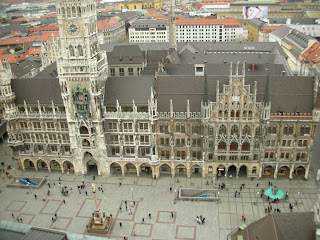
The top view of the Rathaus taken from the St Peter's Kirche. 
Near the Marienplatz, just at the Residenz palace is the Odeonsplatz. This is the place where the so called Munich Beer Hall Putsch was launched by Hitler in 1923 that failed. The name Odeonsplatz got its name from a concert hall Odeon which Ludwig I had it built at the southwest side of the Platz. Two important landmarks can be found at Odeonplatz. One of them is the mustard yellow looking church (the Theatinerkirche) and the other is the Feldherrnhalle (Field Marshall Hall), built betwen 1841 and 1844. This Hall was a symbol of the honours of Bavarian army at that time.


At the entrance of the Hall you could see two lions. It was believed that rubbing on them would bring good luck.
Odeonplatz is also the starting point of the Ludwigstraße (Ludwigsroad) that leads to this triumphal arc called the Siegstor (lit: Victory gate). It is similar in style to the Arc-de-Triomphe which I saw in Paris 2 years ago as well as the Brandenburger Tor in Berlin. This momument was completed in 1852 and used to serve as a display of force of the Bavarian army.

Beer drinking culture in München
München is famous for its beer halls, and the Hofbräuhaus is perhaps the world's largest beer hall. The sad thing is that no Bayern would go there to drink beer nowadays. Most of them head elsewhere outside the Altstadt. As a result, the only (and always crowded) group of people at the Hofbräuhaus are tourists from all over the world.
Beer is ordered usually in 1 mass mugs, which is 1 litre, although there are smaller sizes of 500ml. And the waitresses here are very fit I must say. They could carry like 10 1 mass mugs at one time!

 Inside the beer halls. The layout is such that people sit in long benches rather than round tables, and there will be a band that plays Bavarian music after 7pm. Hofbraühaus also serves food as well, but as compared to other restaurants, the food is not as good.
 Bavarian Food Specialities
Actually in München, it is worth to eat in restaurants. This is because there are so many of them and competition heats up as a result. The prices are reasonable and the portion is alot. The traditional Bayern food is most recommended. Personally I ate at restaurants every night at different places and the bill per person every time for a meal with beer turned out to be only about 13 Euros, which is even cheaper than eating at a German restaurant in Singapore!
 Schweinshaxe mit Kartoffelknödel und Sauerkraut - roasted pork knuckle with potato dumpling and cabbage salad.
 Schnitzel mit Kartoffelsalat - Fried port fillet with potato salad
 Schweinebraten mit Kartoffelknödel- hog pork with potato dumpling
The service at the restaurants were very prompt and the waitresses are all very professional, making sure that you're very comfortable and asking you about the food after you'd eaten. Also, all of them were dressed in the traditional Bavarian traven dress - Trachtenkleid, which is a distinctive dress costume which reveals a huge part of their cleavage.

 Having eaten at 3 different restaurants at München, I must say that the Augustiner Braühaus serves the best tasting traditional Bayern food. It is a must that I return there to eat again in summer.
Allianz Arena
The Allianz Arena is a football stadium at the North outskirt of the city, and was one of the venues for the 2006 FIFA world cup. It is the resident stadium of the soccer club Bayern München and 1860 München. What is more interesting however is the design of the stadium itself. Because of its structure, it has been nicknamed as an inflatable rubber boat. During the day the stadium looks very normal in design. However at night, the whole stadium would light up, and the light changes colour as well! The most beautiful colour in my opinion would be when the red light mixed with the white, but however, I waited for 40minutes and the red light had not come yet.. so I decided to go. Moreover it was freezing out in the open. Hopefully this summer when I go there again I could get the shot of the red lit stadium.


Parks in München
München is a green city with a handful of beautiful parks and gardens. I visited the Schloß Nymphenburg which is the biggest baroque palace in Germany. The Gardens are free although it costs money to enter the palace.
 Front view of the Schloß
Olympiazentrum (Olympic Area)
In 1972, München hosted the Olympic Games. Now in 2008, this area is still very well preserved and the area has turned into a large garden and parks. The view from the top of the hill is breathtaking.


Other popular parks in München includes the Englischer Garden, designed by and Englishman in 1789, larger than New York Central Park. During summer, it is a norm to see everyone, well not everyone but almost, sunbathing naked in the Englischer Garden. Also there is a Chinese tower in the Englishcer Garden at which more beer gardens can be found!
An expensive but beautiful and livable city
München has been rated as one of the most expensive places to live in the world. The hostel rent for example can go as high as 350Euros. Moreover, München is very cosmopolitan, like London. It does not give you the feeling that you are in Germany, because 7 out of 10 people you see on the streets are holding maps and they are clearly not Germans. Despite the cost of living, München is probably one of the most interesting and beautiful places to live in Germany.


 This photo was taken from the side of the Altstadt, where most of the tourist attractions are.

 Located on the top of the mountain, the Festung offers a great view of the city below as well as the Alps:

 The most popular street (can be compared to the Orchard Road) that runs through the Altstadt is the Getreidegasse (lit Corn Alley). It is quite a narrow but long streets and the shops line up in a row as seen above. One of the thing which caught my attention the most was the shop signs hanging out of the shop. It turns out that actually this street is acutally famous for old-style professions and trades in the past, and tradition still continues although much of these trades have been replaced with businesses like Nordsee, Mcdonalds, Jack Wolfskin and Zara, but still it is interesting to see each of these businesses' signpost.


