Tuesday, April 8, 2008

Füssen

The Disneyland palace soaked in snow
It was hailing in Füssen when I visited the town, small but however came into limelight because of two castles situated there - Hohenschwangau and Neuschwanstein. Honestly the weather was totally unanticipated. I had only 1 layer of clothing and wore track shoes instead of boots. But it turned out to be a delight to see the Neuschwanstein in snow, more popularly known as the Disneyland palace, or the palace of all palaces in the world, or the gem of all gems, whichever you wanna call it.
The trip to Füssen from München took about 2 hours. And as expected, almost everyone on the train were tourists.
Füssen Bahnhof - Train station
Vom Bahnhof zu den Schlösser (From the train station to the castles)
From the train station, we had to take a bus to the foot of the hill where both castles were. The moment we alighted from the bus, I could see the outstanding, glittering, pearl Neuschwanstein standing proudly on top of the hill:
The snow on the trees made it look like cottonfields. Neuschwanstein at the top.
The foot of the hill was lined up with restaurants, gift shops, guesthouses as well as hotels. All were gracefully designed and painted. As we could see, the whole place was very touristic as millions of people flock to Füssen every year to visit Neuschwanstein.


Schloß Hohenschwangau (lit - Palace of the "High Swan District")

After walking along the pathway at the foot of the hill, the first of the two palace we saw was the Hohenschwangau. Its mustard like colour gleamed in the snowly weather that day. The earliest records of the palace were first mentioned around the 12th Century. In 1829 King Maximilian II of Bavaria discovered the historic site and was attracted to the beauty of the surrounding area. He acquired the property in 1832, and reconstruction began till 1837. Thus, his successor the romantic, eccentric and mad king Ludwig II of Bavaria (who was later declared insane) spent most of his childhood living in Hohenschwangau.

How Hohenschwangau looked like at the foot of the hill - it is actually very accessible on low ground and does not require much climbing.

The exteriors of Hohenschwangau

From Hohenschwangau to Neuschwanstein

We took a walk to Neuschwanstein from Hohenschwangau. Although Neuschwanstein was built on a level 200metres above ground level, reaching it was quite easy because there was a pathway built to the castle and the main road was cleared of snow. Depending on the pace, most people would take between 30-45 minutes to reach the top. Most people chose to walk up towards the castle....

... while others took a horse ride.

Some very beautiful scenes along the way up to the castle

Schloß Neuschwanstein (lit: Palace of the New Swan Stone)

Neuschwanstein's design was largely attributed to Ludwig II who succeeded throne after Maximillian II. The beauty and flawlessness of the palace, together with the jaw-dropping exterior illustrated the vivid fantasy and romantic ideals of Ludwig II. It was a product of his conception of the idea. However, during the time of its construction from 1869 - 1886, it was a hefty cost to the royal treasury and the finances almost went bankrupt. The castle was near completion in 1886 when the King was declared insane and moved to Schloß Berg, and was mysteriously found drowned in Lake Stanberg in 1886. Before his death, the palace was never opened to public, but after his death, his ministers decided to open his public for the purpose of recovering the strained budget spent on the castle. Indeed, it proved to be one of the best decisions made for today, the palace is a real money spinner for the state as one of Germany's top tourist destinations, and the palace has also appeared in Cinderella and Sleeping Beauty's movies, therefore giving it the reputation of the Disneyland castle.

The view of Neuschwanstein as we approached the main entrance

The front view of Neuschwanstein


Inside the main courtyard of Neuschwanstein

Der Weg zur Marienbrücke

Before coming to Füssen and visiting Neuschwanstein, I have seen many pictures and postcards of the palace. One particularly famous spot for photographs which appeared on postcards were taken from the Marienbrücke (Mary Bridge). The spot of the Marienbrücke was also believed to be first discovered by Ludwig II who commissioned the building of the bridge later on. The problem is during winter or when there is snow, the path to the bridge is not being cleared of snow and could pose a life hazard. In spite of that, I wanted to see how it look like and risked almost crawling to the bridge. Crawling because it was so difficult to walk in the snow with track shoes, not to mention tiring since there was no hard ground to step on. But the photographs are a testimony that it was worth the effort and the risk.

Snow on rocks in a stream

A restaurant

Entering the Marienbrücke

The palace from the Marienbrücke - A fairytale gem indeed


Along way down from the Marienbrücke. Notice part of the Alps in the background, as well as the small Hohenschwangau in yellow at the right hand side. The view is simply breath taking.

Altstadt Füssen

Indeed, Füssen is a popular destination these days because everyone flocks to visit the two palaces above, and queues to enter the Neuschwanstein especially could take up to 2 hours. And when they are done with the palaces, most of them would then quickly rush to take the train back to München or Salzburg. And as a result, the Altstadt was left largely unvisited and untouched like a virgin. I spent an hour in the Altstadt and I must say that there are really some interesting and beautiful sights:

The river, which the water was emerald green (much more of a darker tone than the one I saw in Salzburg)

Heilig Geist Kirche, with one of the windows looking like a Seashell.

A castle within the Altstadt


The main shopping district in the Altstadt.

Füssen is a beautiful place, and the two palaces really live up to their names. I am intending to visit it again this summer with Py, Teresa and Ying and I am pretty sure they will marvel at the sights of the palaces as well.

http://picasaweb.google.com/vintagebin/20MarFSsen

Sunday, April 6, 2008

Dachau

"Dachau - the significance of this name will never be erased from German history. It stands for all concentration camps which the Nazis established in their territory."

Such were the words inscribled on a panel at the bus stop leading to the concentration camp the moment I alighted from the bus.

From Nürnberg I went to München (Munich) and established my base for the next few days there during which I would go out for day trips and return. Dachau, not pronounced at "Da-chau" but rather "Da-how", was one first such trip. About 20km northwest of München lies Dachau. And it was at this town where the beginnings of the concentration camp model first began as early as 1933.

This camp was initially used as the purpose for a concentration camp for political prisoners, right after the Nazis formed the government in Germany and began to think of ways to expel all their political opponents.

The entrance to the camp

Arbeit macht frei - Works brings you freedom

Arbeit macht frei - Behind the metal gates, the word "frei" does not exist however.

The original term came from a German nationalist in 1872 and was popularised by the Nazis during the early 20th century. The phase was placed at a number of Nazi concentration camps as a form of declaration that self-sacrifice (in the case of the prisoners) did bring about some kind of spiritual freedom. Of course this is definitely not true, since the prisoners there were meant to work to death, unless one would consider death as a form of freedom.

The camp museum

Inside the main building where it used to consist of much of the adminstrative offices as well as the prisoners' eating and laundry area is today a museum tracing the roots of Nazism from the period where Germany lost the WW1 and the Kaiser abdicated to the formation of the Dachau concentration camp right till the period after WW2. The museum entrance is free, but not recommended for kids below 12 because of some of the content in the form of torture and horror pictures may be too hard for them to swallow.

I happened to see some German military officials here as well. I think its good and important for them to know their country's dark past.

Top: An explaination of how one of such corporal punishment were carried out, and below: the instrument used.

The metal rungs used to hang the prisoners and whip them. Today the bars are being dismantled but you can still see the drilled holes.

Perimeter fencing of the camp. Before the fencing you could see a "trench like" path dug around the perimeter. This was the prohibited zone. If the prisoner enters this zone, the guard at the watchtower would shoot him. According to the display, it stated that some of the prisoners went into the zone on purpose of being shot to end their misery.
Sleeping Beds for the prisoners. It was reported that by 1937 and 1938 when the numbers of prisoners grew exponentially, the number of beds were insufficient to such an extent that it was common to see 5-6 workers stuffed into such a space.

The Camp road, on which on both sides the prisoner barracks are built. Today they are all demolished.
The Crematorium Area
At the corner of the camp lies the Crematorium Area. This area is notorious for its place as an execution area.

There are two buildings. The above one is the "new crematorium".

The process of systematic killing

The chamers were first used to disinfect the clothing with prussic acid poison gas. Such took place in the disinfection room above. The victims were told to remove their clothes and that they were going to take a shower.

Then the victims were brought into this room disguised as a shower room. The ceiling was installed with fake water shower sprouts to make the whole thing look real. At the side of the room, where the square tiles are, are where the flaps where the poison gas pellets were inserted from outside.

Incinerator Room - where each of the four furnaces could cremate two to three corpses at once.

Another form of execution would be hanging, as you see from the hooks below. The victims are hung directly above furnance. So that they can conveniently be cremated after that.


Pistol shooting range

Although Dachau concentration camp was not a concentration camp with the purpose of mass and systematic killings like Auschwitz in Krakow, Poland, this camp is significant because it was the first concentration camp and most of the other concentration camps which the Nazis opened after that was largely based on Dachau camp model.

http://picasaweb.google.com/vintagebin/19MarDachau

Saturday, April 5, 2008

Nürnberg (Nuremberg)

The story of a city that saw the rise and fall of Nazism
I could remember I first saw the name Nürnberg (or Nuremberg in English) when I started learning History in Sec 1. And I was glad I had the chance to visit this city. Today despite its dark history during the 20th century, it is the second largest city in Bayern (one could easily guess what the largest city in Bayern is). And so from Bamberg I took the train to Nürnberg, arriving in the evening. I spent a total of one day and two nights there, maximising every time I have to cover all of the city as well as to meet up with Cynthia. Actually she does not live here, but she's here on a dance course and will go back to Ausgburg when school reopens.

The Altstadt

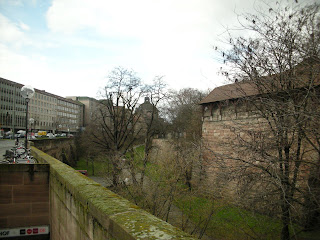
Here you see the "kiam chye" map with all the circles, crosses and sketchy routes which I clutched for most of my time here. The Altstadt of Nürnberg is enclosed by the town walls. And at every corner of the wall there is a tower. Actually the whole city was flattened by the Allies in 1945 and as a result the Altstadt was painstakenly rebuilt from the heaps to restore what it looked exactly like in the past. Therefore all the walls, together with some of the jewels in the Altstadt were rebuilt replicas.

One of the first few pictures that I took when I arrived that evening. Part of the town wall. Notice that the U-Bahn (subway train) runs through it. Another part of the wall nearby the Hauptbahnhof
The front entrance of the Nürnberg Hauptbahnhof.

I was pleasantly surprised upon arriving at Nürnberg. Firstly I found the train station above to be beautifully designed. And the sunset lighting made it look more beautiful. Secondly the Altstadt is immediately right at the doorstep of the train station, which means the first thing I saw when I stepped out the train station was already the town walls.

Nürnberger Wurst

Nürnberg sausages are one of the best in Germany. Although they can be bought off the supermarket shelves and cooked, but the best, authentic sausage here is made on the spot upon ordering, so says the menu as they justified the waiting time. Nürnberg sausages are different from most of the other German sausages because they are firstly, much shorter, and they do not curl and in terms of thickness not as thick. It is hence like a mini sausage, if you'd want to call it this way.

Nürnberg Sausages with potato salad and dark beer

Another street favourite is 3 of such sausages stuffed into bread with thick mustard. Although it is quite fattening I must say, it is still a delight to wash it down with beer. And everyone does it on the street, even people you'd normally don't expect to associate with junk food - such as elderly people as well as girls with great looks and figueres gobbling down on that with beer. Well but I guess to have a sense of proportion, this is probably not junk food in Nürnberg context.

Hauptmarkt in der Altstadt (Main market)

The best time to visit Nürnberg is actually not during easter but rather during the christmas period because of its spectuclar Weihnachtsfest (christmas market). But other times of the year we could see that at the centre of the Altstadt stalls are set up.

The Martplatz is also the place where the Gothic looking Frauenkirche (Women Church) as well as the Schöner Brunnen (Beautiful Fountain), a golden fountain of Jewish and Christian heros as well as other figures stands.Also, if you could see from the map above, there is a river that cuts through the Altstadt. The picture above is one of the bridges. A rebuilt replica of the previous building before it was bombed in WW2.

The Kaiserburg (Imperial castle)

At the north end of the Altstadt stands the Kaiserburg. In this self contained castle is today a museum which shows the King's living quarters and a well which still yields drinking water. Also, it is possible to get a picture of the city from this the Kasierburg.

The 40metre well is located not in the tower but in the house beside it.

The rise and fall of Nazism

Most people who visit Nürnberg tend to forget or leave out this area called the Reichsparteisgelände (Nazi party compound). Firstly it is located outside the Altstadt and secondly, there is well, honestly not much to see. However it is an integral part of the history of Nürnberg as well as Germany for this is where we see how the Nazis carried out its rallies as well as propaganda speeches. The Nazis first bought over a vast area of this land in the 1920s and developed this land to be the area for rallies. The rallies soon became a content of propaganda as well as anti-semetic policies.

Indeed, Nürnberg is the place where the infamous rallies began, the boycott of Jewish business began, as well as the place where the Nürnberge Rassengesetzte (Nürnberg Raciallaws) which stripped the Jews of their citizenships were enacted.

The stadiums which were used for their rallies. Below you see a hall which was never completed. Hitler intially intended for it to look like the Roman Colosseum.

The way to the Frankenstadion (venue for the 2006 World cup). The glory of today with the dark past of yesterday. In fact the Frankenstadion was once the former marching grounds for the Hitler youth as well.

Venue of the Nürnberg Trials in 1946.

2 km from the east of the Altstadt lies the Nürnberg Palace of Justice, as it was named. It was the place where the trial of war criminals were carried out in 1946 after the war. I suppose the trials were chosen for the symbolic reason because of its association with the Nazis during the war. Today the place is still used as a court, and the trialroom of the war, is especially used for murder trials.

http://picasaweb.google.com/vintagebin/1718MarNRnberg

Bamberg

The long overdue post
I spent much of my Easter holidays in the state of Bayern (Bavaria). To many people, the state Bayern = Munich. Although there is a tendency for me to see why this is so, I do not really agree. And it is also this reason which also led to other German towns rarely explored. And Bamberg is one of such places, although I think there are other cities which are more ulu than this one.
Altstadt
The town of Bamberg was lucky to escape from the WWII bombings. Its beautiful Altstadt and magnificant Dome made it to be recognised as a UNESCO World Heritage Site.
I could still remember I arrived at Bamberg on a Sunday afternoon. The Altstadt was seemingly quiet, with the exception of coffee cafes open. It took me quite a while to reach the Altstadt from the train station, about 20minute walk, during which I have to cross two rivers to reach the Altstadt.


This photo was taken from the side of the Altstadt. On the other side where you see the houses above, this row is fondly known as the Klein Venedig (small Venice) because it is taught to resember a part of Venice. Have not been to Venice yet (that will be done in June together with Ying, Peiyong n Teresa!), I am not sure how much of a resemblence it is.

The most popoular site of Bamberg has to be this building. It is the Altes Rathaus (old city hall), which is today a museum. It is beautifully painted, but the main attraction is that the building is actually perched on twin bridges over the river, as seen below.

The Dom in Bamberg is a gigantic Cathedral which overlooms much of the Altstadt.

The Kloster St Michael (Monastery Church)

It was however the Monastery Church which received more of my attention than the Dom. The monastery, in terms of heights, is built at a level higher than the Dom, which means climbing and climbing again. But it was worth it because of the interesting content inside the monastery church:

The church ceiling's not the typical ceiling you'd see at all other churches here. The painting are plants, or to be more precise, medicinal plants. In fact if you walk along the church grounds, you could still see the plants being grown and labelled, not for practical purposes but rather more for display purposes.

Rauchbier (smoked beer)

This is a speciality of Bamberg. At first look it appears very similar to the dark beer which we always drink here. However, the taste is somewhat different. To me it is a taste which has to be accquired, just like smoked meat. There is a smokey pinch of the beer like as though there's smoke in my mouth. And when I swallow it, the feeling is almost like smoking a cigarette, the period after inhaling and before puffing out.

I saw a rainbow in the train along the way to Bamberg. Its nice to see rainbows here because of the long spread over the fields, something which I do not see in Singapore.

http://picasaweb.google.com/vintagebin/16MarBamberg

Thursday, April 3, 2008

internationaler Tag (International Day)

Have not been posting anything for a long time since I came back. Now that the tests are over with one more to go next week, I could take a little rest. Anyway today was international day for the Mannheim students who would be interested to go on exchange, and so every country had a booth as well as flyers sent by their home universities. Even the flag was already hung up there when I went to the booth. As exchange students we just had to be there to show our faces and answer questions. So Zhirui and I were at the booth, together with a German student who just returned from Singapore.


Being very obendient ambassadors of our Universities
Among Asia Singapore was one of the most popular booths and our pamphlets were all given out within an hour. It is interesting to note that there are quite a lot of Germans who are interested to do an exchange in Singapore. Also they seemed worried that there are not enough vacancies and competition will heat up during the application process.  What a pity! But also got to know a couple of people who will be in NUS next sem and exchanged contacts already, although I don't think they'd need any help to find their way around in Singapore.


Srichitra (or Belle) - Neighbours not only geographically but also at the booth.
This is probably the only time you see them so close to each other. And the A4 size paper on the Chinese Flag is acutally the flag of Hongkong.
Will post about the places visited during Easter soon...

Tuesday, March 18, 2008

Away till the 28th Mar

Hi I am typing this entry in Nürnberg now. Its a beautiful city that was restored to what it used to look like (less the Nazis of course) after the allies flattened almost the whole city kaputt at the end of WWII. I will probably not update the blog till I return next week. Happy holidays to those in Germany and good luck to those who should be starting to mug in NUS for their exams!