The colourful city of Germany
I spent my last weekend with about 70 other exchange students as we went to a trip to Hamburg, which is a port city situated at the North of Germany. Hamburg is the second largest city in Germany after Berlin. The journey to Hamburg from Mannheim via bus took us about 9 hours! We left in the middle of the night and arrived the next morning.
The Port of Hamburg
Named Germany's gateway to the world (because Germany is in contentintal Europe, and in the past the only way to access the world by sea would be through the port of Hamburg), it is the second largest port in Europe. From our hostel, we could see a view of the jetty as below. To my dismay, the leftmost tower was under repair!
I spent my last weekend with about 70 other exchange students as we went to a trip to Hamburg, which is a port city situated at the North of Germany. Hamburg is the second largest city in Germany after Berlin. The journey to Hamburg from Mannheim via bus took us about 9 hours! We left in the middle of the night and arrived the next morning.
The Port of Hamburg
Named Germany's gateway to the world (because Germany is in contentintal Europe, and in the past the only way to access the world by sea would be through the port of Hamburg), it is the second largest port in Europe. From our hostel, we could see a view of the jetty as below. To my dismay, the leftmost tower was under repair!


After dumping our luggage at the hostel, we went to the harbour to take a boat ride. It appears that the Singaporeans, me included, were not very excited at all, and the most spontaneous thing which we all said was that Harbourfront is more beautiful, but the other exchange students were excitedly clicking away at all the cargo containers and ships as well as piles of scrap metal which are also all lying at Tanjong Pagar. I was also quite surprised to learn that some of them have never seen such big ships before. I suppose that's difference when two people grow up in different parts of the world.
 holding the German flag on the boat.
Hamburg Speicherstadt (Warehouse "city")
Completed in the late 1880s, this warehouse district was the largest in the world at its time. The length of the row of the warehouses was estimated to be about 1.5km long. It was opened by Bismarck upon completion. The reason for having such a big warehouse district was simple. Based on the fact that Hamburg is a free trade port. Today however, these warehouses are mostly no longer used for storing goods such as tobacco or coffee, although there are still some coffee firms there, but rather some of the most interesting museums are housed in these warehouses.


Miniaturwelt (Miniature World)
The Miniature World is a model railway attraction in Hamburg, and the largest in the world. Although the entrance cost 7 Euros, it was an eye opener. It consisted of 5 sections in it, South Germany, Hamburg, USA, Scandinavia and Switzerland. It attempts to build a miniature version of the cities, as the name suggests, with railways and trains running through it. If you look at the next picture just below, you'd have recognised the Hamburg harbour jetty as well as part of the Warehouse district (second picture). The close resemblance to the real buildings is simply amazing.

 What I found very interesting was the day and night concept. When night falls, the room would be darkened and the buildings would light up. So beautiful is this, in the display of Las Vegas at night below. The miniature world brings people to places which they have never been to before as well as bringing back recollections of places that people have been to before.
Hamburg Hauptbahnhof (main train station) and Rathaus
It is my habit to take pictures of the Hauptbahnhof (abbreviated as Hbf) as well as the station sign (Hamburg Hbf) when I arrive at a new city. So that is why if you see the picasa photo album, the cover picture of all of the cities visited are the railway station signs. Even though I arrived in Hamburg via bus, I went to the Hbf to snap a picture, as well as take a look at how the train station looks like. And as expected, the interior was very big with 18 platforms and a shopping centre. Looks more like an airport than a train station.

The main entrance of the Hbf - I later learned that it was opened in 1906 by Kaiser Wilhelm II (the last emperor of Germany). During its time of opening, it was the only building which was almost fully made of see-through glass. (Today of course not anymore. I think even the Esplanade has more glass than the Hbf)
 At the core of the Innenstadt (inner city) lies the Rathaus (city hall). I was fortunate enough to be there at the right time to get the above shot at dusk. A pity however, that during the next day city trip, we did not stop at the Rathaus to take more pictures. In fact, I did not cover much of the Innenstadt during my trip at Hamburg, which is a pity because there are a lot of beautiful buildings within and I missed quite a lot of them.
  truly global - Singapore, Korea, Holland, Korea, Turkey - my room mates for the weekend
My first German Musical
On Saturday afternoon, most of the people went to the dungeon, which is like a horror house which tells the terrible events which happened to Hamburg in the past, for example, the Great Fire of 1842 which almost swallowed the city. The rest of us, in fact, only 10 of us, went to watch a German musical! I was quite surprised to find out that I was the only Asian out of the 10, because I thought more Asians would be interested. But anyway, I was glad I went to watch the musical because it's my first German musical and hey, it was not as complicated as I thought it would turn out. At least I could understand what was going on and the plot. The title of the musical is called Heiße Ecke (literally "hot corner). Heiße Ecke is actually the name of a store that sells snacks like Currywurst (curry sausage, a German favourite) along the Reeperbahn (a street in Hamburg, which will be mentioned later), and many stories evolve around the store. Something like "Under one roof" kind of concept.
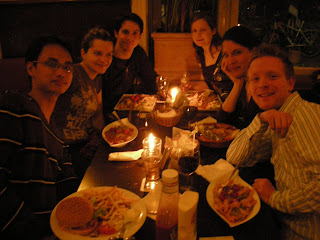
 I realised that majority of the crowd were middle-aged people above the age of 30s. Young people were almost non-existent. And the interior looked more like a beer hall than a musical theatre. There was no dress code, you could order food and beer and sit in round tables while you watch the musical. After the musical some of us went for dinner.


Reeperbahn
The Reeperbahn is the main street that passes through Hamburg's St. Pauli district. This district is famous for the nightlife for Hamburg as well as the cultural and sub-cultural of Hamburg. Cultural because the musical theatres are mostly located here, including the one I went to watch the musical. Subcultural because of the redlight area, striptease bars, sex joints and brothels.

One of the very popular alleys along the Reeperbahn


Eros - the concept of Eros is that women who want to ply their trade will rent a room and then the market themselves via the windows. However after the AIDs scare in the 90s, this Eros was closed down. But of course it does not mean that prostitution does not exist in the area. In fact the alley across the Reeperbahn which the Eros is facing is an alley of glass-windows brothels where the women would stand in front of a the glass panel and passerby can take their pick. I had a look there and found out that the rates were 50 Euros for 20min. So bloody ex! Also, because it is a tourist district, women may tend to want to go and have a peek at the alley too. However this is discouraged by most people even the locals. Firstly it may not be safe and secondly there were incidences that the prostitutes have hurled used condoms at women who wanted to kaypoh because they are not there to frequent their service!
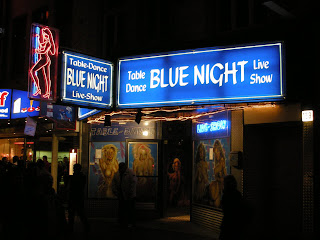 Another concept which is not explicitly having sex is such of a table dance or live show. Used to be a platform for men for alternative thrills, this is also becoming a curious attraction for tourist. However it is important to know that although entrance is free, the compulsory drinks are exorbitant! A glass of coke which is the cheapest drink costs 10 Euros!
 The Fish market is one of Hamburg's must see on a Sunday morning. Although the market opens till bout 10 plus in the morning, the most happening period is just before sun rises, between 5-6am. With only 2.5 hours of sleep after clubbing the previous night, I forced myself to crawl out of bed and dragged my feet to the fish market, which was thankfully, very near to the hostel.
 It turns out that you don't just buy fish at the fish market. The main highlights are stalls selling fruits and vegetables. What would happen is that the sellers would lay empty baskets, and then start filling them to the brim with different fruits and vegetables, and would sell it for 10 Euros. Not a bad deal actually, by German standards of pricing. And they're really generous. You could ask for one more bunch of bananas for example, and they'd jus go .. OH... Scheiß egal! (oh! shit that's not a problem!)
Reminds me of the chinese new year stalls at Chinatown earlier this year, where we could eat all we want at the stalls. However here we could not only try out the fruits but also fill the basket to the brim.

The buyer asked - How long is the "Zehner" (10, 10, 10 Euros) going to last? The seller replied - been going on the whole of last night... together with my wife! Also check out the whole load of stuff for 10Euros
 Other finds included German bread, which is a hell of big loaf....
 as well as German cheese (Käse)....
 ... Specialities (sweets) from all around the World, Self service
 this building was the original fish market of the past. When it started, all the trading activities would take place inside there. Today all the stalls are set up outside and inside is a beer hall where there are benches to eat and drink as well as .....

On the way back - Bergpark and Schloss Kassel Wilhelmshöhe
The Schloss Wilhelmshöhe (1798) is a palace in the city of Kassel in central Germany. We stopped by on the way back to Mannheim. With just only an hour to spare. This palace was home to Elector Wilhelm and later Kaiser Wilhelm II. The reason why you see the word Napoleonshöhe is because Wilhelm II offered the defeated French Emperor Napoleon III to live here after France lost to Germany in the Franco-German War in 1871, which resulted in the complete unification of Germany then.

Facing the palace is a castle called the Löwenburg (Lion castle). This castle stands on top of the hill and was quite concealed from the bottom if you'd look up from the palace. Because there is another more prominent structure facing the palace that lies at the centre whereas the Löwenburg is mostly covered by trees. I was glad I saw it from the bottom and made my way up just in time before they close the gates of the castle.


front view of the castle

The courtyard, thankfully I got in just in time before they locked the gates.

View of the palace from the castle.

A lake that is at the bottom facing the palace at the bottom of the elevated hill.
Afterthoughts about the Hamburg trip
2.5 Days could have been sufficient to cover Hamburg actually. However I felt that despite spending that amout of time there we did not cover some parts of Hamburg, which I felt were very important, for example the 2 lakes in the Innenstadt as well as many of the beautiful structures which I missed out. At the same time, there were a lot of waiting time in between which I felt was a serious drawback. This could have siginificantly reduced if there were lesser people on the trip and decision making can be made faster.
Hamburg is a beautiful city. I would definitely want to return to Hamburg again, and I hope to be able to do so in Summer when the sun sets at 10pm. Also I learnt from Laura (my levelmate) today during dinnertime that Hamburg is her hometown.


 I have to admit that this is by far the ugliest Rathaus (city hall) I have ever seen. A check online revealed that the Rathaus was acutally built between 1970 and 1974 by Danish architects using Swedish marble, which probably was like the Esplanade of the day, but thought by many as being not pleasant looking.


